Column Based Mezzanine
A floor that stands on its own, and carries more because of it.
Column Based Mezzanine
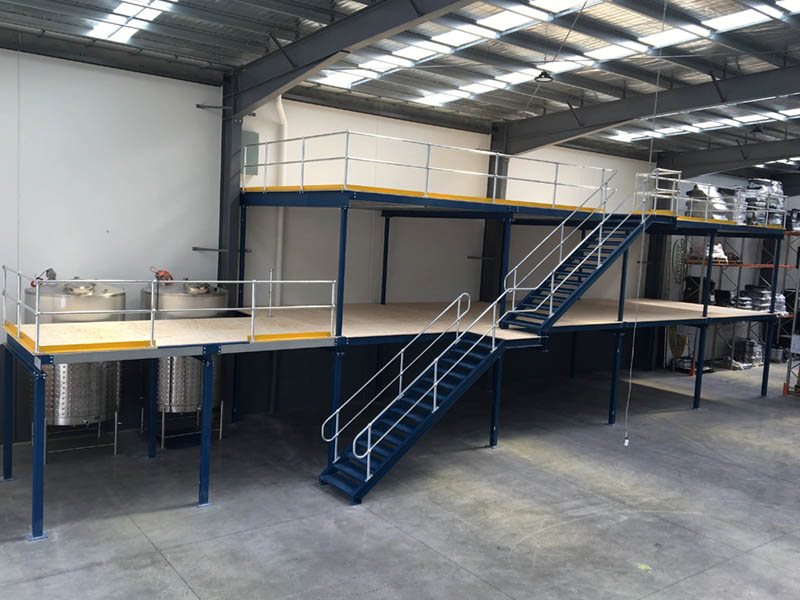
A column based mezzanine does not lean on your racking for support. It stands on its own steel columns, which means the floor above is structurally independent and can carry meaningfully heavier loads than a racking-supported design.
That independence also means more flexibility in the column grid, so the layout gets designed around how you actually plan to use the space, not around where the racking below happens to sit.
Why choose this system.
Independent structure, not dependent on racking below
Higher load capacity than racking-supported designs
Column grid designed around your layout, not a template
Doubles as storage or a genuine working floor
Built to your requirement.
| Type | Column-supported mezzanine |
| Floor load | Medium to heavy, per design |
| Deck | Chequered / steel / board |
| Finish | Powder-coated |
Values are indicative. Final specifications are engineered for each project.
Typical applications
The engineering behind it.
Independent steel columns carry the entire structure, so the floor above is not dependent on the racking or shelving below it for support, unlike a rack-supported design. This independence allows for a flexible column grid, spaced to suit your actual layout rather than matching a racking module underneath, and typically supports higher floor loads than a rack-supported or slotted angle alternative.
Column spacing is usually 3 to 6 metres, with heavier steel and closer spacing used where floor loads are higher or where the space below needs to remain genuinely open, for forklift access or wider aisles, without columns interrupting it.
What buyers usually ask.
Why choose column-based over rack-supported mezzanines?
Column-based structures carry heavier loads and give you a flexible column grid independent of what sits below. Rack-supported designs are more economical but tie the mezzanine's footprint to the racking layout underneath it.
Does this restrict forklift access on the ground floor?
Column spacing can be planned specifically to keep forklift aisles clear. This is one of the main advantages of an independent structure, the ground floor layout is not constrained by what is happening above.
What load capacity is realistic for this format?
Meaningfully higher than a rack-supported or slotted angle mezzanine, often suitable for genuine storage or light machinery use. Exact capacity depends on column spacing and beam sizing, engineered to your specific requirement.