Live Pallet Racking
FIFO that does not depend on anyone remembering.
Live Pallet Racking
Ask how stock rotation is supposed to work and you will get a clear answer. Ask how often it actually happens that way under pressure, and the answer gets murkier. Live pallet racking removes the question entirely.
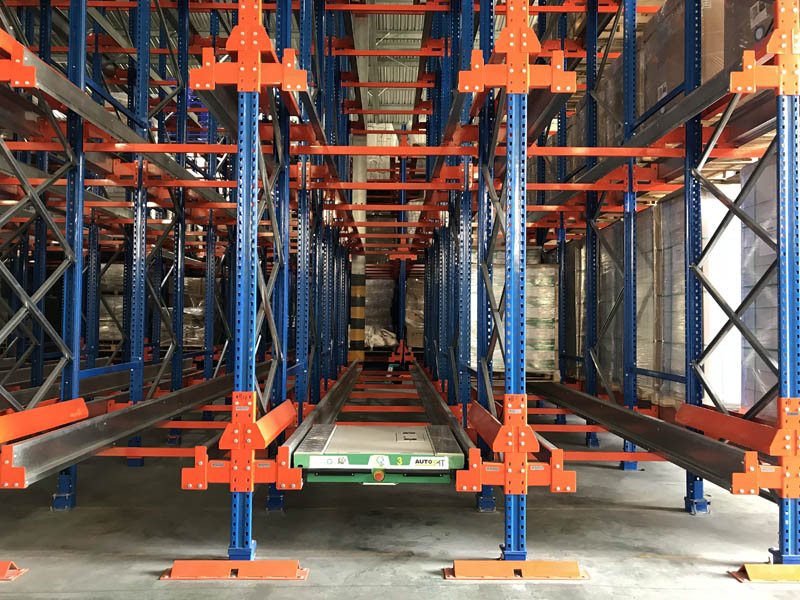
Pallets load at the back and roll forward on inclined lanes as stock is picked from the front, so the oldest pallet is always next, not because someone checked a date, but because the system makes any other order physically impossible. Built for dated stock, and for warehouses that cannot afford a rotation mistake.
Why choose this system.
FIFO rotation enforced by gravity, not policy
Dense lane storage without losing access discipline
Separate load and pick faces keep traffic apart
Speed controllers keep pallets moving safely, not fast
Built to your requirement.
| Type | Gravity flow, FIFO |
| Lane depth | Engineered to need |
| Load | To design |
| Finish | Powder-coated steel |
Values are indicative. Final specifications are engineered for each project.
Typical applications
The engineering behind it.
Each lane is built on a slight incline, typically 3 to 5 degrees, with rows of rollers or wheel tracks running its full depth. Pallets loaded at the high end roll forward under gravity as stock is removed from the low end, so the pallet that has been in the lane longest is always the one presented for picking. Speed controllers, either brake rollers or a governed track, keep pallets moving at a safe, walking-pace speed regardless of load weight.
Lane depth is engineered to your pallet dimensions and typical order quantity, commonly 4 to 8 pallets deep for a standard operation. Deeper lanes increase density but tie up more stock mid-lane, so the right depth depends on how fast a SKU actually turns, not just how much floor space is available.
What buyers usually ask.
Does live racking need more maintenance than static racking?
Rollers and lane alignment need periodic inspection, more than static racking but meaningfully less than most other mechanical storage systems. We recommend a check every six months for high-turnover lanes.
Can live racking handle mixed pallet weights in the same lane?
Yes, within the rated range for that lane, but speed controllers need to be set for your heaviest expected pallet to keep flow safe across the full weight range you plan to store.
Is live racking worth it if I do not have strict FIFO requirements?
Usually not on cost grounds alone. Live racking costs more per position than selective or double deep racking, and that premium pays back fastest specifically where rotation errors are expensive, dated stock, food, pharma. For general goods without a rotation requirement, other formats are usually more cost-effective.