
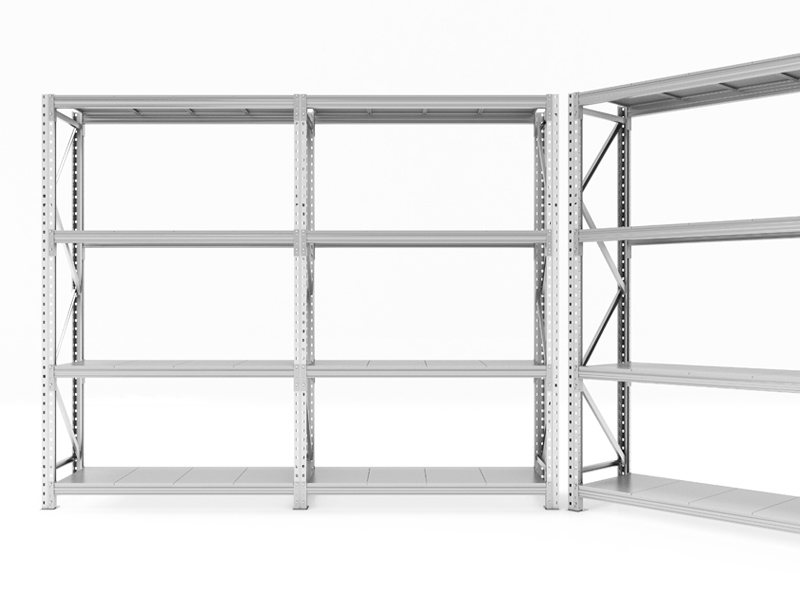
Slotted angle and long span shelving get confused for each other often enough that it is worth being clear about the difference, because choosing wrong means either wasted budget or shelving that cannot carry what you need it to.
Slotted angle: flexible and economical
Slotted angle bolts together from perforated steel angle sections, which makes it fast to assemble and endlessly reconfigurable as your storage needs change. It suits lighter loads, typically under 200 kilograms per shelf, and shines in stockrooms, workshops and retail back-of-house where the mix of items stored shifts often.
Long span: built for weight and clear reach
Long span shelving uses boltless beam construction across wider spans with no central column obstruction, which lets it carry medium to heavy loads, generally 300 to 800 kilograms per shelf, in deep, clear bays. It is the better fit for cartons, totes, spare parts and e-commerce picking stock that is heavier or bulkier than slotted angle is rated for.
The decision in practice
If your items are light, your storage needs change often, and cost per bay matters most, slotted angle wins. If your items are heavier, you need a clear deep shelf without cross-bracing in the way, or you are storing awkward cartons and totes, long span is the better engineered choice.
Load capacity, in real numbers
Slotted angle shelving typically handles somewhere in the range of 100 to 250 kilograms per shelf, depending on configuration and shelf material. Long span shelving, built with heavier beams and a wider clear span, typically carries 300 to 800 kilograms per shelf on the same footprint, sometimes more depending on the specification. If your stock is genuinely heavy or dense, that gap matters more than the price difference between the two systems.
Reconfiguration: where slotted angle genuinely wins
Slotted angle shelving bolts together and comes apart with basic tools, which makes reconfiguring a run, adding a shelf, changing spacing, extending a row, something warehouse staff can do themselves in an afternoon. Long span shelving can also be reconfigured, but the heavier components make it a bigger job, better suited to occasional rather than frequent layout changes.
Deck material choices that actually affect performance
Long span shelving typically offers a choice between steel panel decking and particleboard. Steel costs more but handles moisture and heavier point loads better. Particleboard is more economical and perfectly adequate for evenly distributed, moderate loads. Slotted angle shelves usually run in steel, board or ply, with the same basic trade-off between cost and load tolerance applying.
The mixed-system approach most stockrooms actually need
Very few operations are purely light or purely heavy in what they store. Most stockrooms and small warehouses genuinely benefit from running both systems side by side, slotted angle for small parts and light, varied stock, long span for cartons, totes and bulkier items, rather than trying to force one system to do both jobs adequately.
Neither system is better in the abstract. The right one is decided entirely by what actually sits on the shelf.
The wrong shelving system does not fail dramatically, it just quietly limits what you can store and how fast you can pick it.
We manufacture both systems in-house and can help you match the right one to your actual load profile rather than defaulting to whichever is cheaper on paper. Send us your typical item weights and we will tell you honestly which system fits.