
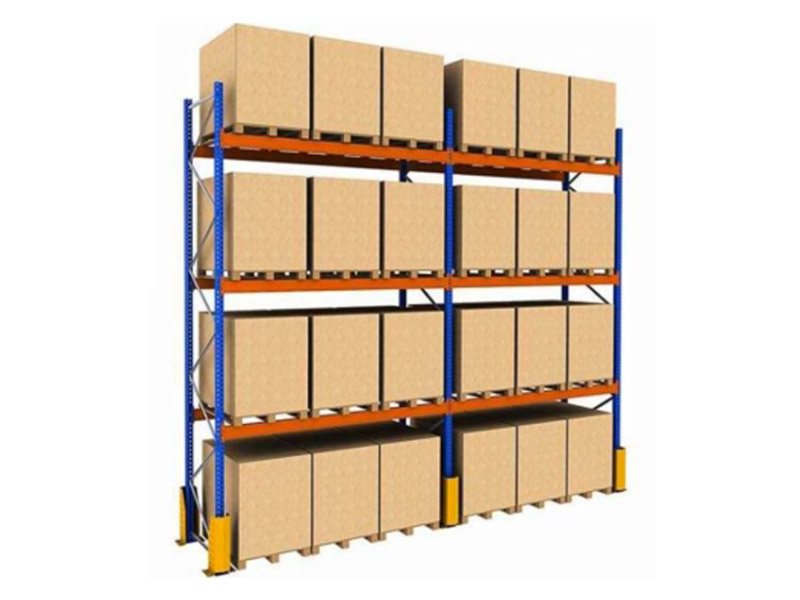
If you have ever walked into a warehouse, the racking you saw was most likely selective pallet racking. It is the default system for good reason: every pallet is reachable directly from the aisle, which makes it the fastest system to pick from and the easiest to plan around.
How selective racking actually works
Selective racking is built from vertical upright frames connected by horizontal beams, forming levels you load and unload with a forklift or reach truck. Because there is no need to move other pallets out of the way, any SKU on any level is accessed in one movement. That single feature is why it remains the backbone of Indian warehousing, from 3PLs to manufacturing stores.
Where selective racking makes sense, and where it does not
Selective racking is the right call when you carry a wide mix of SKUs and need to pick individual pallets often. It is the wrong call when you are storing a small number of SKUs in bulk, since it uses more aisle space than double deep or drive-in systems and gives up some density in exchange for full accessibility. Getting this trade-off right at the design stage saves you from redoing the layout later.
Sizing it correctly the first time
The mistakes we see most often are beam levels set without checking pallet overhang, load ratings applied per bay instead of per level, and aisle widths chosen around today's forklift without room for a reach truck later. A proper design starts with your pallet dimensions, your heaviest SKU, and your building's clear height, not a catalogue drawing.
Getting the beam load rating right
Every selective racking system has two load figures that matter: the per-beam-level rating and the per-bay rating. Buyers regularly focus on one and ignore the other, then find out the hard way when a fully loaded bay behaves differently from a single overloaded shelf. A proper design accounts for both, and for how the load is distributed across the pallet footprint, not just the total weight.
Aisle width decides more than you think
A narrower aisle packs in more racking, but only if your forklift can actually turn in it without repeated shunting. Standard reach trucks typically need a wider aisle than very narrow aisle (VNA) equipment, which costs more but can cut aisle width significantly. The right answer depends on your throughput: a high-turnover operation often earns back the VNA investment fast, a low-turnover one rarely does.
Common mistakes we see on selective racking projects
The same handful of errors show up again and again. Beam levels set without checking actual pallet height, so clearance is either wasted or too tight. Load signage that never gets updated after the racking is repurposed for something heavier. Frame protectors skipped at aisle ends, which is exactly where forklift impact concentrates. None of these are expensive to get right at the design stage. All of them are expensive to fix afterward.
What a proper quote should include
A specification, not just a price. That means beam and frame load ratings for your actual pallet weight, a layout drawn to your building's real column spacing and door heights, and installation, not just delivery of steel. If a quote is missing any of these, it is missing the parts that actually determine whether the racking performs.
Selective racking is simple in concept and easy to get wrong in the details. The details are where the safety and the performance actually live.
The best racking design is the one built around how you actually pick, not how a brochure says you should.
We design, manufacture and install selective pallet racking in-house, engineered to your load and building rather than a standard template. If you are planning a new store or reworking an existing one, our team can walk your site and size it properly before a single upright goes up.