
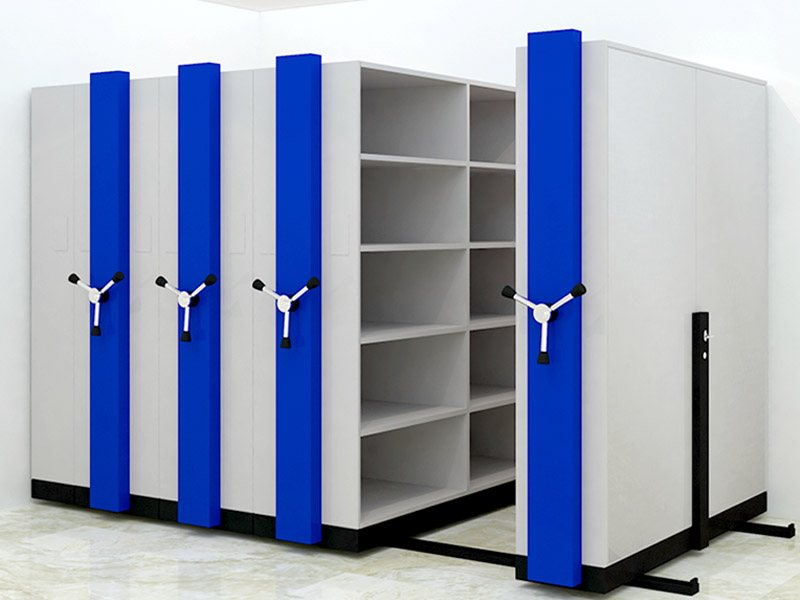
A mobile compactor system puts racking on wheeled carriages that roll along floor tracks, so only one aisle needs to be open at a time instead of every aisle sitting empty and unused. The space that would normally be lost to fixed gangways becomes usable storage instead.
The capacity gain is real, but so is the trade-off
Because you are only opening one aisle at a time, you can typically store close to double the volume of static racking in the same footprint. The trade-off is access speed, only one aisle is open at any moment, so operations with very high pick frequency across many locations at once will feel that constraint more than an archive or slow-moving stock area will.
Where mobile compactors are the clear winner
Archives, cold storage, spare parts, and any inventory that is accessed occasionally rather than constantly are ideal candidates. In these settings, the density gain comes at almost no operational cost, because you are rarely opening more than one or two aisles in a working session anyway.
Where static racking still wins
High-throughput picking operations, where multiple pickers need simultaneous access across the whole storage area, generally do better with static selective or double deep racking. Compactors are not designed for that access pattern, and forcing the fit usually costs more in lost throughput than it gains in density.
The density number that actually matters
Mobile compactors typically deliver close to double the storage of static racking in the same floor area, by removing all but one open aisle at a time. That figure gets quoted often, but the more useful number is density per rupee spent, since compactor systems cost meaningfully more per position than static racking. For expensive real estate, cold storage, or archive space where every square foot is genuinely costly, that extra spend pays back fast.
Access speed is the real trade-off
Static racking gives you instant access to every row, all the time. A mobile compactor requires opening the correct aisle first, which takes seconds for a motorised system, longer for a manual one. For low-frequency access, records, seasonal stock, archived documents, that delay is irrelevant. For a fast-moving pick zone, it can become a genuine bottleneck, which is why compactors rarely make sense for your highest-velocity SKUs.
Manual, mechanical or motorised: how to actually choose
Manual compactors, moved by hand crank, suit smaller systems with infrequent access. Mechanical assist reduces the physical effort for larger runs. Fully motorised systems make sense once a compactor run gets long enough, or gets accessed often enough, that manual operation becomes a genuine time cost across a working day. The right choice depends on access frequency more than on budget alone.
Where static racking still wins outright
Anywhere access speed and simplicity matter more than raw density, active pick zones, fast-moving pallet storage, anything a forklift needs to reach quickly and often. Compactors are a density tool for lower-frequency storage, not a universal upgrade over static racking. Treating it as one leads to installing the wrong system in the wrong zone.
More storage in less space sounds like an easy win. It only is one if the goods you are storing do not need to be accessed in a hurry.
Density and access speed sit on opposite ends of the same trade-off. The right system is the one that matches how often you actually need multiple aisles open at once.
We manufacture mobile compactor systems in manual, mechanical and motorised drive options, sized to your load and space. If you are choosing between compactors and static racking, we can help you make the call based on your actual access pattern, not a generic recommendation.