
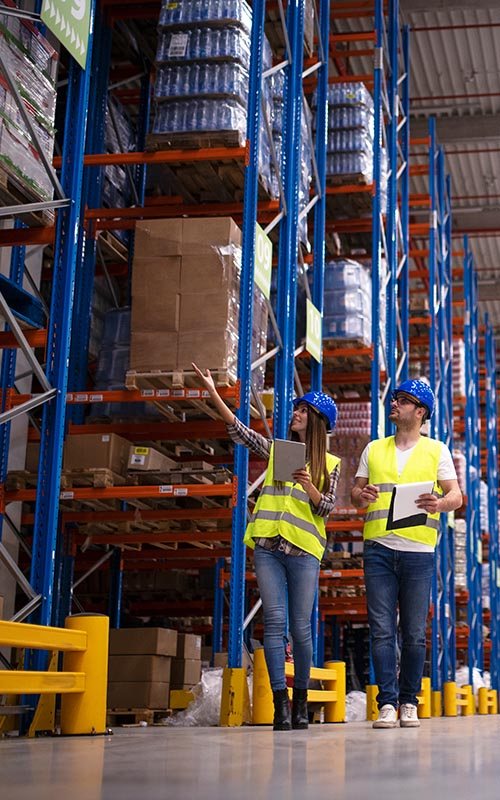
Operators moving into quick commerce often plan their first dark store using the same logic that built their traditional warehouse, just smaller. That approach consistently underperforms, because the two formats are solving different problems.
Footprint changes everything
A traditional warehouse can absorb an inefficient layout decision because there is room to spare. A dark store, typically under a few thousand square feet, cannot. Every metre of aisle and every shelf level has to justify itself, because there is no slack in the floor plan to hide a bad decision in.
SKU density per square foot is the real metric
Traditional warehouse design often optimises for pallet throughput. Dark store design optimises for SKU count per square foot, since the entire value of the format is carrying a wide catalogue in a tiny space close to the customer. That shifts racking choice toward shelving and multi-tier systems far more than pallet racking.
Pick logic is built around minutes, not shifts
A traditional warehouse measures picking performance in orders per shift. A dark store measures it in minutes per order, sometimes single-digit minutes. That difference changes where fast movers sit, how aisles are laid out, and how tightly the whole space is zoned around the pack station.
Racking choice reflects the difference
Traditional warehouses lean heavily on pallet racking. Dark stores lean on shelving, slotted angle, long span and multi-tier systems, sized for cartons and totes rather than pallets, because that is what actually moves through a dark store's catalogue.
Footprint and location: the fundamental difference
A traditional distribution centre optimises for scale on cheap land, usually well outside city centres. A micro-fulfilment centre optimises for proximity, deliberately trading floor space for a location close to the customer. That single trade-off cascades into almost every other design decision that follows, racking density, pick path length, catalogue size.
SKU density per square metre: where micro-fulfilment has to win
Because urban real estate is expensive per square metre, a micro-fulfilment centre has to extract far more SKU density from its footprint than a traditional warehouse ever needs to. That usually means multi-tier shelving, tighter aisle configurations, and a layout designed around bin sizes rather than pallet sizes, formats a traditional warehouse rarely needs to lean on this hard.
Pick speed expectations are simply different
A traditional warehouse fulfilling next-day orders can tolerate pick times that would be commercially unworkable for a micro-fulfilment centre supporting rapid delivery. That difference in acceptable pick time drives fundamentally different layout priorities, proximity of fast movers to packing matters far more in a micro-fulfilment context.
Which model actually fits your business
If your customer base is concentrated in dense urban areas and speed is the competitive edge, micro-fulfilment usually wins despite the real estate premium. If you are optimising for cost per unit shipped across a wide geography without a tight delivery promise, traditional warehouse economics usually still win. Few businesses need to choose only one.
These are not the same problem at different scales. They are different problems that happen to both involve racking.
Shrinking a warehouse design does not make a dark store. Redesigning around minutes and SKU density does.
We have designed both formats extensively, and we bring dark-store-specific thinking to every quick-commerce fitout rather than a scaled-down warehouse template. If you are planning your first dark store, this distinction is worth getting right from day one.