
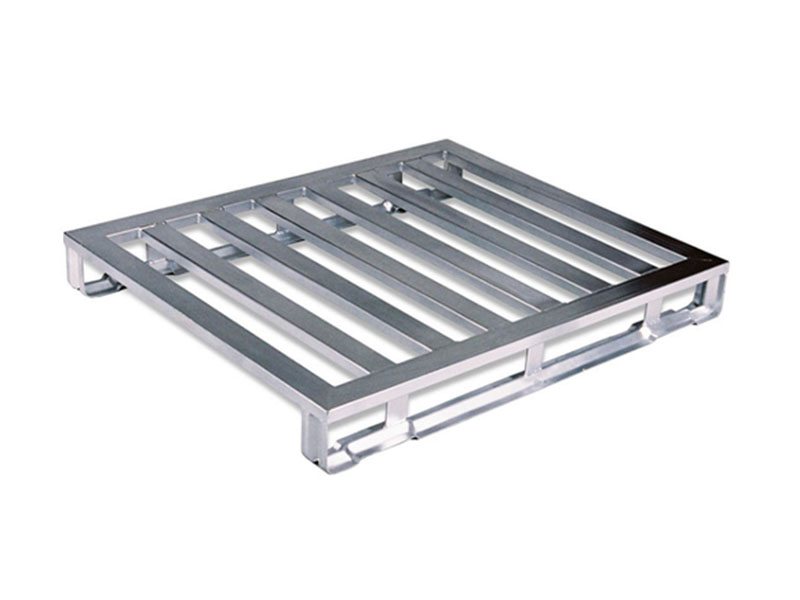
Metal pallets get treated as a commodity purchase more often than they should be. Getting the specification right, entry type, load rating and finish, makes a real difference to how well the pallet performs in your actual operation.
Entry type: 2-way versus 4-way
A 2-way entry pallet accepts a forklift from two sides only, which is fine for operations with predictable, consistent handling flow. A 4-way entry pallet accepts a forklift or pallet jack from any side, giving handling flexibility that matters more in operations where staging and retrieval directions vary. This decision affects handling speed more than most buyers expect.
Load rating: rated for what, exactly
A load rating means little without knowing whether it reflects static load, in racking, or dynamic load, being moved and handled. Ask specifically which condition the rating covers, since a pallet rated well for static racked storage is not automatically rated the same for constant forklift handling.
Rackable versus stackable design
Some pallets are designed to be rackable, supported at the edges on beam racking, while others are designed to be stackable, bearing load from pallets stacked directly on top. These are different structural requirements, and a pallet optimised for one is not automatically safe for the other.
Finish for your environment
Galvanised finish suits outdoor or high-moisture environments. Powder coating suits most indoor industrial use and offers better appearance for customer-facing storage areas. Matching finish to environment extends service life meaningfully.
Flat, mesh or custom: how to actually choose
Flat metal pallets suit general palletised goods where you need a solid, even surface. Mesh designs work better where drainage, airflow or visibility through the pallet matters, washdown environments, produce, anything that needs to breathe. Custom designs earn their cost when your load shape or weight distribution genuinely does not fit either standard format.
Entry type: 2-way versus 4-way access
A 2-way entry pallet can only be lifted from two sides, which is fine if your forklift access is predictable and consistent. A 4-way entry pallet can be lifted from any side, adding flexibility in tighter or less predictable warehouse layouts, at a modest cost premium. If your operation moves pallets through varied paths, 4-way access usually pays for itself in handling flexibility.
Rackability: a detail that is easy to overlook
Not every metal pallet is designed to be placed directly into racking, some are meant for floor stacking only. Confirm rackability specifically if you plan to store loaded pallets in selective or double deep racking, since a non-rackable pallet placed on a beam is a genuine safety risk, not just an inconvenience.
Matching the pallet to the load, not the other way round
The most common mistake we see is a business buying a single standard pallet type for every load in the warehouse, then wondering why some goods sit awkwardly or shift in transit. Engineering the pallet around your actual load, weight, footprint, fragility, prevents that entirely.
A pallet range built around your load, not a generic size, pays for itself the first time something heavy or awkward needs to move safely.
A metal pallet looks simple. Specifying it correctly is not, and getting it wrong shows up as handling inefficiency you will feel every day.
We manufacture metal pallets across flat, mesh and custom configurations, engineered to your load and handling pattern. Tell us how you actually move and store product, and we will recommend the right specification.