
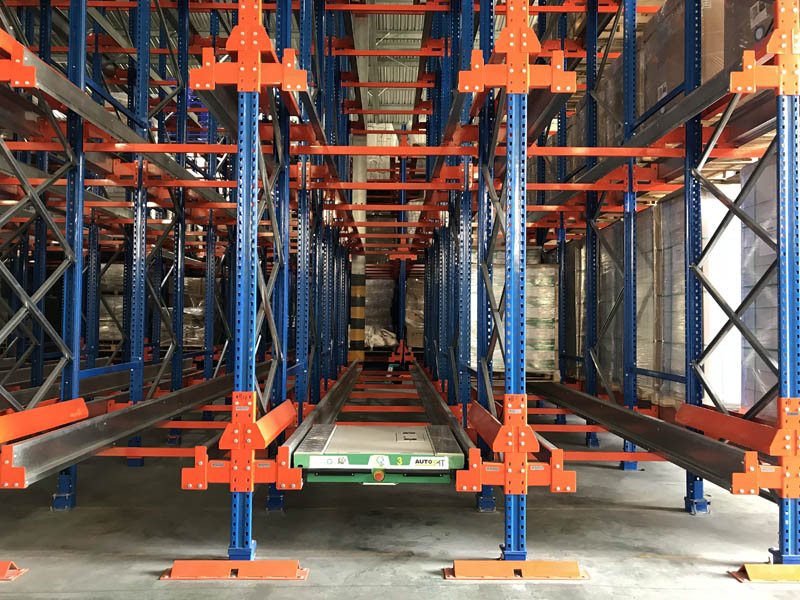
Most warehouses rely on people to enforce first-in-first-out rotation, and people make mistakes, especially under pressure. Live pallet racking removes that dependency by using gravity to do the job automatically.
How the gravity flow actually works
Pallets are loaded at the high end of an inclined lane fitted with rollers, and they move under their own weight toward the pick face as stock ahead of them is removed. Loading and picking happen on opposite sides of the system, which keeps traffic separated and rotation automatic, with no manual intervention needed to keep FIFO discipline intact.
Where the investment pays off
Live racking earns its cost fastest with dated or perishable stock, food and beverage, pharmaceuticals, and any SKU where selling the oldest batch first genuinely matters. The density is also strong, lanes pack pallets tightly with only load and unload aisles needed, not a full aisle grid.
What it is not the right fit for
If your SKU mix does not require strict rotation, the added cost and mechanical complexity of live racking over static selective racking usually is not justified. It is a purpose-built solution for a specific problem, not a general upgrade.
Lane depth: the specification most buyers get wrong
A live pallet racking lane needs to be sized to both your pallet dimensions and your actual turnover rate, not just fitted to the available bay width. A lane that is too deep for your turnover ties up capital in slow-moving stock sitting mid-lane. One that is too shallow does not deliver the density gain you installed the system for in the first place. This is a calculation, not a guess.
Roller speed control: why it is not optional
Without proper speed control, a fully loaded pallet can accelerate down an inclined lane fast enough to damage itself, the pallet behind it, or the end-of-lane stop. Speed controllers, sized to your actual pallet weight, keep the system's core benefit, automatic rotation, from becoming a safety hazard. This is one part of a live racking spec that should never be treated as a place to cut cost.
Where the extra cost genuinely pays back fastest
Live racking costs meaningfully more per position than selective racking, which is exactly why it does not belong everywhere. It earns that cost back fastest in food, beverage, and pharmaceutical operations where a single stock rotation mistake, an expired batch reaching a customer, a recall triggered by poor traceability, costs far more than the price difference between racking formats ever will.
Maintenance most buyers do not budget for
Rollers wear over time, particularly in high-turnover lanes, and periodic inspection of roller condition and lane alignment is part of keeping a live system safe and functional. This is a genuinely lower maintenance burden than most mechanical storage systems, but it is not zero, and it is worth budgeting for from the start rather than treating it as a surprise years in.
Live racking is not just density with a clever mechanism attached. It is the only standard racking format that makes correct rotation physically unavoidable.
FIFO enforced by physics does not have a bad day. FIFO enforced by a checklist sometimes does.
We design live pallet racking with proper lane engineering and speed controllers for safe, controlled flow. If rotation discipline is a recurring headache in your operation, this is worth evaluating properly rather than living with the workaround.