
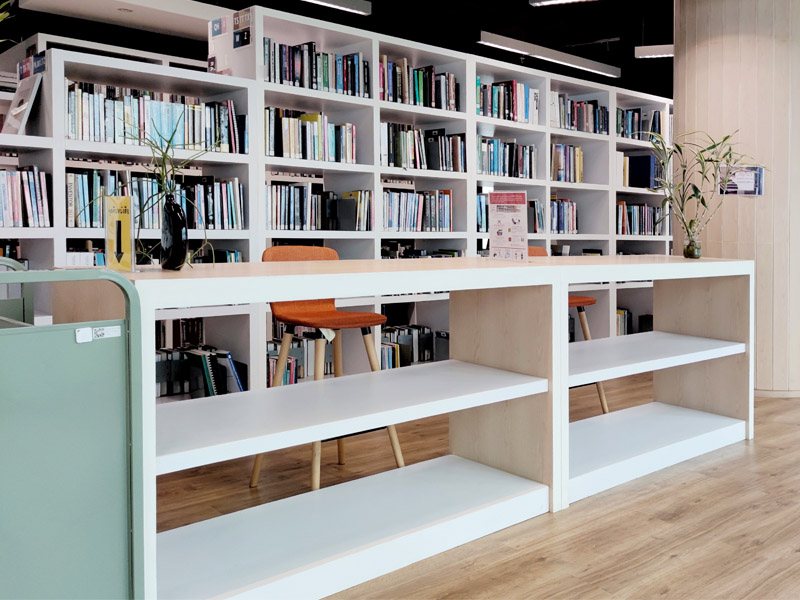
Library and institutional storage gets asked to do something warehouse racking never has to: perform under constant public handling, day after day, for decades, while still looking presentable the entire time.
Durability under a completely different kind of use
Warehouse racking is handled by trained staff following a routine. Library shelving is handled by the public, constantly, unpredictably, and without any handling protocol at all. That means smoother edges, stronger shelf supports, and a stability margin well beyond what a similarly loaded warehouse shelf would need.
Static versus compactor-based systems
Static shelving suits collections with steady, predictable growth and ample floor space. Compactor-based systems, where shelving moves on tracks to eliminate fixed aisles, suit institutions that need to fit a growing collection into a space that is not growing with it, archives and academic libraries in particular.
Shelving people actually want to browse
Unlike warehouse picking, library access is about browsing, people scanning spines, not retrieving a known location as fast as possible. Shelf height, spacing and sightlines need to support that behaviour, which is a genuinely different design brief from warehouse slotting logic.
Finish that ages well in a public space
A finish that looks fine on day one but shows wear within a year is a poor investment for a space the public sees daily. Durable, easy-to-clean finishes matter more here than in a warehouse setting most customers never enter.
Static versus compactor-based library shelving
Static shelving remains the right default for most reading rooms, it is simple, low-maintenance, and never gets in the way of casual browsing. Compactor-based shelving makes sense specifically where a library needs to fit a meaningfully larger collection into a smaller footprint, at the cost of only one aisle being open at a time, a fair trade for archives and less-browsed collections.
Shelf height and reach: designing for real users
Library shelving serves a genuinely wide range of users, from young students to elderly readers, which means shelf heights need to stay within a comfortable, safe reach range throughout, not maximise capacity at the expense of accessibility. This is one area where warehouse-style vertical stacking simply does not translate.
Finishes that suit a public, shared space
Institutional shelving takes constant public handling, so the finish needs to resist scuffs and cleaning chemicals without looking industrial. A powder-coated finish in a considered colour reads very differently in a reading room than the same steel construction would in a warehouse, and that visual difference genuinely matters in a public-facing space.
Planning for a growing collection
Collections grow steadily over years, rarely in the sudden bursts a warehouse inventory might see, but growth is still growth. Leaving genuine expansion capacity in the initial shelving plan avoids an awkward, disruptive reconfiguration of a working reading room a few years down the line.
Library storage has a job warehouse racking never does: it needs to be walked through, not just picked from.
Library shelving has to be furniture and infrastructure at the same time. Most racking only has to be one of those things.
We manufacture library and institutional storage in both static and compactor formats, designed for the specific durability and browsing needs of public and academic spaces. If you are planning a new library or archive fitout, we would be glad to help.