
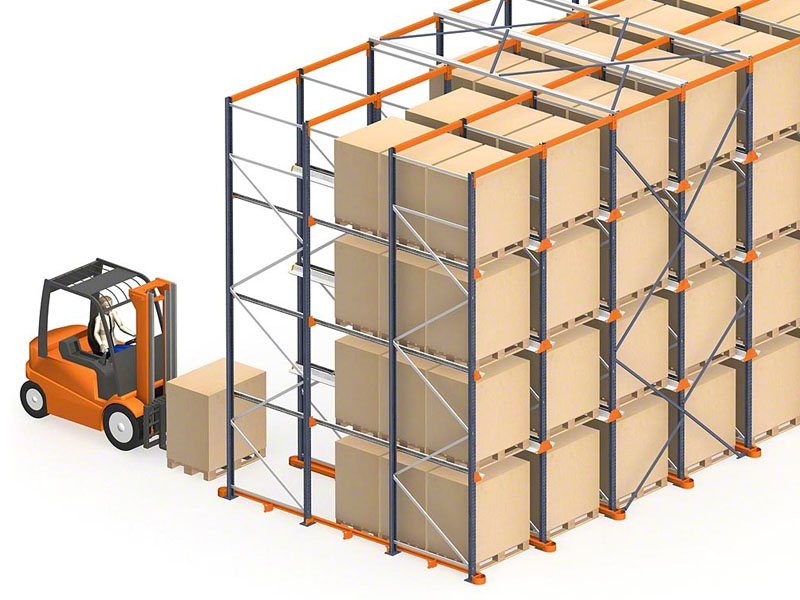
Double deep racking is the natural next step once selective racking stops being dense enough. It stores pallets two positions deep instead of one, trading a little accessibility for a meaningful jump in capacity.
Where the density gain actually comes from
By removing the aisle you would need for the second pallet position and pairing rows back to back, double deep typically recovers around 30 percent more pallet positions in the same footprint compared to selective racking. The saving comes almost entirely from fewer aisles, not from taller racking or tighter beams.
The trade-off you need to plan for
Every double deep position needs the pallet in front of it to belong to the same SKU, or you lose access to what is behind. This system rewards operations with a handful of pallets per SKU and punishes operations with many single-pallet SKUs. It also requires a double-deep reach truck with an extending fork, which is a different piece of equipment and a different skill set than a standard reach truck.
Getting the fit right before you commit
The question to ask before choosing double deep is simple: for your top moving SKUs, do you typically hold two or more pallets at a time? If yes, double deep is usually a strong fit. If your inventory is spread thin across many SKUs with one pallet each, selective racking will likely serve you better and cost less to operate.
The equipment cost most buyers underestimate
Double deep racking itself does not cost dramatically more than selective racking per position. What catches buyers off guard is the reach truck. A standard reach truck cannot access the rear pallet position, you need one fitted with a pantograph or telescopic fork, and that equipment upgrade, whether purchased or rented, is often the real deciding cost in a double deep project, not the racking.
How to know if your SKU profile actually fits
Double deep racking rewards operations where you regularly hold two or more pallets of the same SKU at once. If your inventory is a long tail of single-pallet SKUs, the format's density advantage never really gets used, since you are still only storing one pallet deep in most positions. Run the numbers on your actual pallet-per-SKU average before committing, it tells you more than any racking brochure will.
Rear pallet damage: a real risk worth planning for
Because the rear pallet only gets accessed once the front one clears, damage to that rear pallet, from moisture, pests or simple age, can go unnoticed for longer than in selective racking. This matters more for some goods than others. For anything perishable or moisture-sensitive, factor this into your decision, or consider live racking instead if strict rotation matters more than raw density.
A realistic density comparison
On the same floor area, double deep typically delivers around 30% more pallet positions than selective racking, largely from removing every second aisle. That is a meaningful gain, but it is well short of drive-in racking's density, which can exceed it substantially for operations that do not need any mid-lane access at all. Where you land between the two formats depends entirely on how much access flexibility your operation actually needs.
Double deep is a genuine density upgrade, but only for the SKU profile it was built for. Get that match wrong and you are paying for equipment you barely use.
Density is not free. The right racking system is the one that matches how your inventory actually behaves, not the one with the highest pallet count on paper.
We help customers work through this trade-off before committing to a design, using real SKU and pallet data rather than a rule of thumb. If you are outgrowing selective racking and want to know honestly whether double deep is right for you, our team can walk through it with you.