
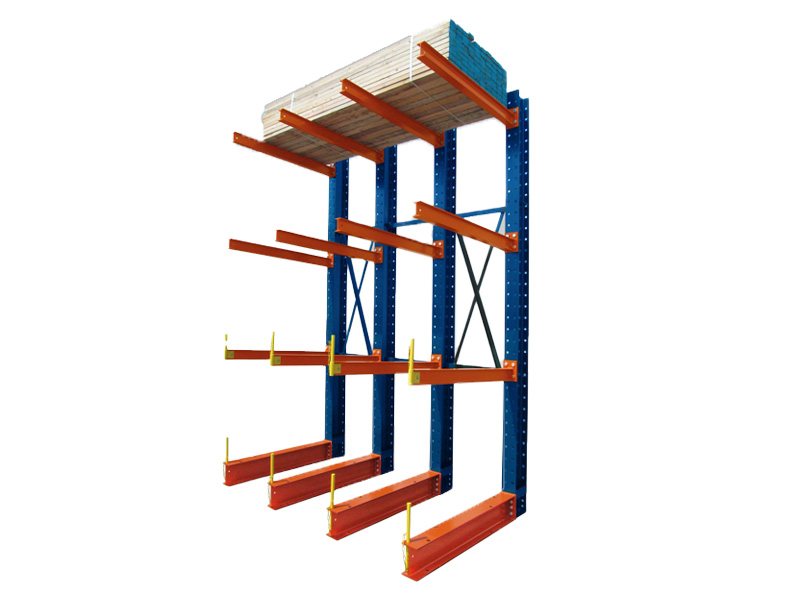
Standard pallet racking assumes a fairly uniform, boxed load. The moment you are storing pipes, timber, steel bar, extrusions or large sheet material, that assumption breaks down, and that is exactly the gap cantilever racking is built to fill.
Why the design is different
Cantilever racking uses arms that project out from a central column, with no upright frame in front of the load. That clear front face is the entire point: long items load and unload from the side without threading between columns, which is impossible with standard frame racking once a load exceeds a couple of metres.
Single-sided versus double-sided configurations
A single-sided system works well against a wall or where access is only needed from one direction. Double-sided cantilever, arms projecting from both sides of a central column, is the more space-efficient choice when you have aisle access on both sides and want to maximise storage density for long-goods inventory.
Sizing arms and columns correctly
Arm length needs to be set for your longest common load, and arm load rating needs to reflect how loads are actually distributed across it, a load resting near the tip puts far more stress on the arm than the same weight close to the column. This is one of the areas where a generic catalogue spec can leave real capacity on the table, or worse, understate it.
Why arm spacing matters more than arm length
Buyers often focus on how long the cantilever arms are, when arm spacing, the vertical distance between arm levels, is just as critical for actual load capacity. Arms spaced too far apart let long items sag under their own weight between support points. The right spacing depends on the stiffness of what you are storing, not a generic standard pulled from a catalogue.
Indoor versus outdoor: a genuinely different spec
Outdoor cantilever racking, common in timber yards and steel stockists, needs corrosion protection that indoor systems simply do not, galvanising rather than powder coating in most cases, plus foundation considerations for wind loading that never come up indoors. Specifying an indoor-rated system for an outdoor yard is a mistake that shows up as rust and structural concern within a couple of years, not immediately.
Single versus double sided: it is a floor space decision
Single-sided cantilever racking against a wall makes sense when floor space is genuinely tight. Double-sided, with arms projecting from both sides of a central column line, roughly doubles storage density per column and makes more sense where you have the floor space to dedicate a wider aisle to it. There is no universally right answer, it depends entirely on what your building actually allows.
What we check before quoting a cantilever system
The actual weight and length distribution of what you plan to store, not just an average. Whether loading happens by forklift, crane or hand, which changes the clearance and access requirements significantly. And whether the environment is indoor, outdoor, or somewhere in between, like a covered but unwalled yard, which needs its own specific corrosion approach.
Cantilever racking looks simple from the outside. The engineering that keeps it safe under a genuinely long, heavy load is anything but.
If your inventory does not fit neatly on a pallet, it probably does not belong on pallet racking. Cantilever exists for exactly that inventory.
We design cantilever systems for indoor and outdoor duty, sized to your actual load profile rather than a standard arm length. If pipes, timber, profiles or panels are eating up floor space they should not need, this is worth a conversation.