
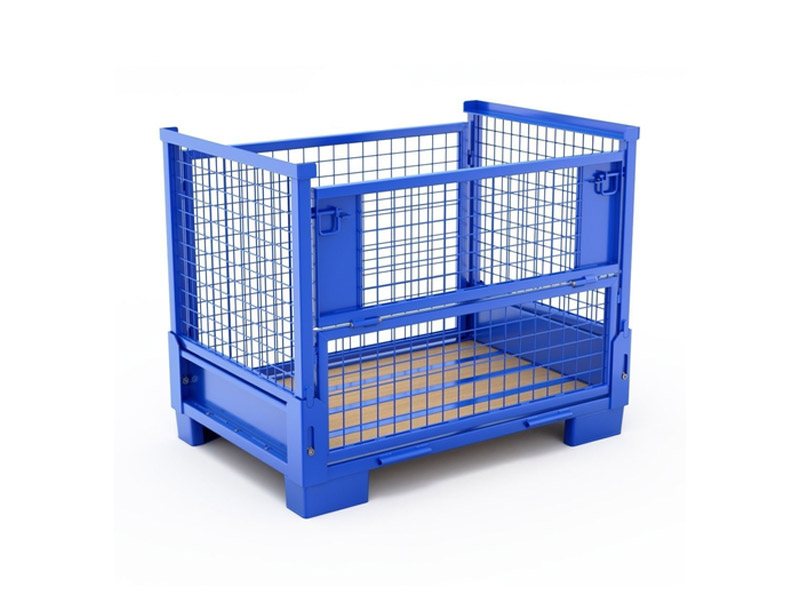
Loose or irregular parts stacked on a flat pallet are a familiar sight in manufacturing and warehousing, and a familiar source of both damage and near-miss incidents. Cage pallets solve a problem that flat pallets were never designed to handle.
What a cage pallet actually solves
A collapsible steel cage keeps loose items physically contained during transit, storage and handling, which cuts down on parts falling, shifting or being damaged in the process. For automotive components, small hardware, and any inventory that does not stack cleanly on its own, this containment is the entire value proposition.
Why stackability and foldability both matter
A well-built cage pallet stacks safely when loaded, which keeps density up in storage, and folds flat when empty, which matters enormously for return logistics and empty storage space. A cage that only does one of those two things well ends up either wasting storage space when empty or being unsafe to stack when full.
What to check before you specify
Confirm the rated load capacity matches your actual part weight. Do not judge it by how sturdy the cage looks. Check the locking mechanism is secure but still fast to operate, since these get opened and closed constantly on a busy floor. And verify the finish suits your environment, galvanised for outdoor or high-humidity use, powder-coated for most indoor applications.
What actually determines a cage pallet's real capacity
The rated load capacity should match your actual part weight, not just look sturdy. Confirm the rating against your specific parts, not a generic catalogue figure, and check that the locking mechanism holds securely under load without needing to be forced. A cage that looks robust but has a weak locking point is a genuine hazard once stacked and loaded.
Stacking safely: what to check before you stack three high
Cage pallets are designed to stack, but only when loaded within rated capacity and stacked on a level, stable surface. Never stack a partially collapsed or damaged cage. A dent in a corner post that looks cosmetic can be a genuine structural weak point once another loaded cage sits on top of it.
Folding mechanisms: the detail that saves real storage space
An empty cage pallet that does not fold flat is dead storage space taking up a footprint identical to a loaded one. Confirm the folding mechanism is smooth and does not require force, since a cage that is awkward to fold tends to simply not get folded by busy staff, defeating the entire point of the design.
When a cage pallet beats an open flat pallet
Anywhere you are handling loose, small or irregularly shaped components that would otherwise need to be boxed or bagged separately. The cage does that containment job on its own, which saves packaging cost and handling time across a high volume of movements.
Confirm the rated load capacity matches your actual part weight, not just the cage's structural appearance.
The parts that damage a shipment are rarely the heavy ones. They are the loose ones that had nowhere secure to sit.
We manufacture cage pallets engineered to your load and stacking requirement, not a generic catalogue size. If loose parts handling is causing damage or safety concerns on your floor, this is a straightforward fix.